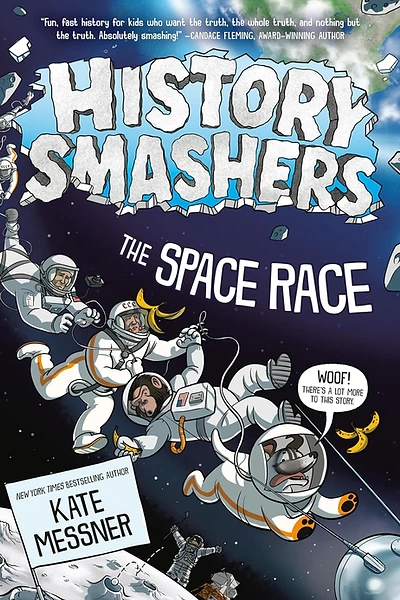
| Graphic Panels | Notice how these panels provide a humorous pause to digest dense historical information. |
| Callout Boxes | Teach these as 'fast facts' that break the rhythm of the main paragraph flow. |
| Transition Paragraphs | Identify how the author bridges the gap between Cold War politics and scientific milestones. |
| Image Captions | Point out how captions move the reader's eye and control the reading speed. |
| Chapter Openers | Discuss how chapter titles set the stakes for the upcoming historical investigation. |
| Interviews | Look for shifts in pacing when the narrative voice switches to a first-person perspective. |
| Bold Text | Use bolding to teach students how to identify the main idea quickly. |
| Question Headings | Analyze how asking a question at the start of a section forces the reader to slow down to find the answer. |
| Historical Timelines | Observe how these compress time to show a sequence of fast-paced failures and successes. |
| Maps | Use maps to ground the reader's pace in geographical reality. |
| Myth-Buster Icons | Explain these as rhythmic triggers for the reader to pay extra attention. |
| Dialogue Bubbles | Discuss how dialogue accelerates the pace of the narrative. |
| Biographical Sidebars | Show how these act as 'brakes' to highlight individual human stories. |
| Technical Explanations | Notice the change in vocabulary density that requires a slower, more careful read. |
| Humorous Annotations | Identify these as a stylistic choice to keep the reader's tone lighthearted. |
| Glossary Terms | Teach students to pause when encountering new, emphasized vocabulary. |
| Primary Source Quotes | Notice how these shift the weight of the narrative back to history as it happened. |
| Conclusion Summaries | Examine how the end of chapters provides a rhythmic 'cool down' period. |
| Author Notes | Teach these as an extra layer of pacing that explains the meta-process of writing. |
| References to Pop Culture | Highlight how these bridge the past to the reader's modern experience. |
| Sentence Length Variation | Show students how short sentences increase the intensity of the Space Race atmosphere. |
| Pacing of Failure | Analyze how failures are described quickly to match the 'try, fail, repeat' cycle of space tech. |
| Pacing of Success | Notice the descriptive, slow-motion language used during major landing events. |
| Paragraph Breaks | Explain that frequent breaks are designed for shorter attention spans. |
| Recurring Icons | Help students recognize icons as pacing markers for different content types. |
| Interactive Prompts | Point out where the author forces the reader to stop and think. |
| Comparison Tables | Use these to compare US and Soviet progress in a single glance. |
| Footnotes | Explain their function as 'extra credit' information for curious readers. |
| Chapter Subheadings | Treat these as rhythmic beats that guide the reader through sections. |
| Pacing of Conflict | Look for how political tension is paced through rapid listing of events. |
| Visual Analogies | Analyze how illustrations explain complex concepts without slowing down the reading speed. |
| Emotional Anchors | Teach students to slow down when the text shifts to the human cost of the race. |
| The 'Smash' Factor | Examine the dramatic irony used to pivot from a myth to the truth. |